Best Practices
How QR Code Tagging Improves Inventory Tracking for Teams
Learn why QR code tagging improves inventory tracking with faster scans, clearer accountability, and real-time asset visibility.
Keep this page as the broad QR-tagging overview, then route readers into setup, physical-label engineering, and small-team workflow guides.
- QR Code Inventory Tracking Hub · hub overview
- QR Code Inventory Tracking Setup Guide for Small Teams · related article
- QR Code Tag Placement, Durability, and Size for Teams · related article
- Asset Tags With QR Codes: Types and Placement · related article
Audience: Teams exploring why QR tagging improves asset tracking before implementation
QR Code Asset Tracking Guide · guide
QR Code Asset Tracking · feature page
If your team still relies on spreadsheets or manual lookups, QR code tagging is usually the fastest way to make physical assets identifiable and scannable in real workflows.
This page explains why QR code tagging works, where it improves accountability, and when it becomes more practical than manual inventory tracking. If you need detailed label-engineering or laptop/peripheral tagging rules, use the more specific guides linked below.
🧠 The Problem with Traditional Inventory Tracking
Inventory management used to mean:
- Logging items in spreadsheets
- Searching by name or ID
- Manually updating statuses
- Physically checking availability
This leads to:
- Lost or unreturned items
- No clear ownership
- Time-consuming audits
- Confusion and frustration
“We didn’t know who had the mic or when it went missing — spreadsheets weren’t helping.”
If your “system” is still a shared spreadsheet, this breaks down why it fails as soon as you need history, ownership, and audits: Why Spreadsheets Don’t Work for Asset Tracking (And What to Use Instead).
📱 What Is QR Code Tagging?
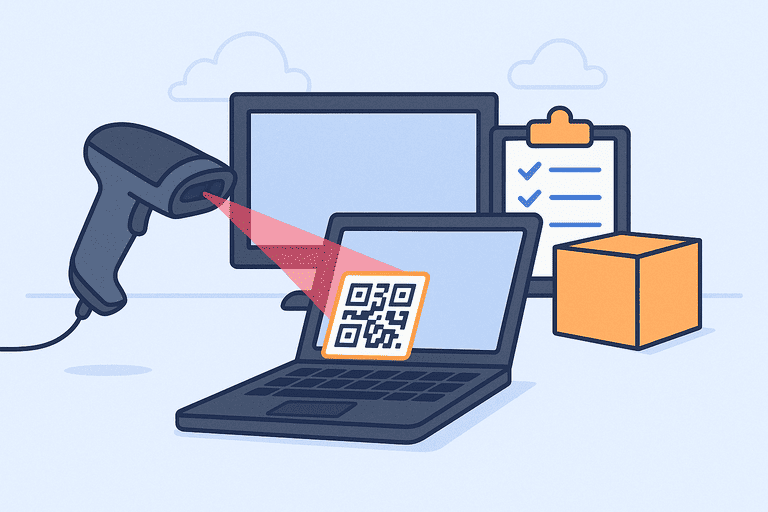
A QR (Quick Response) code is a scannable square that links to digital information. In the context of inventory, each QR code connects to a specific item in your tracking system.
When scanned, a QR code can instantly show:
- Item name, condition, location
- Who it’s currently assigned to
- Usage history and availability
- Options to assign, return, or verify
🚀 5 Ways QR Code Tagging Improves Inventory Management
1. Instant Identification
No more searching rows in a spreadsheet. One scan pulls up the exact item with all its data.
2. Fast Check-In/Check-Out
Easily assign or return items in seconds — from a phone, tablet, or desktop.
3. Accountability Built In
Log who has what, when it was taken, and for what purpose. Reduce loss and improve responsibility.
4. Real-Time Visibility
See what’s available, in use, overdue, or reserved — across all locations and teams.
5. Simplified Audits and Verifications
Scan assets during audits or inventory checks to instantly confirm presence and status.
"QR codes made our inventory audit go from hours to minutes."
To standardize audits across teams (what to check, how often, and what evidence to keep), use: Inventory Audit Checklist: What to Verify and How Often.
🧰 How to Start With QR Code Tagging
- Catalog your assets — name, ID, location, etc.
- Generate QR codes — using a tool like InvyMate
- Print and attach labels — on visible, durable surfaces
- Scan to assign and track — via mobile or desktop
- Monitor everything — from a real-time dashboard
For real-world label durability (placement, materials, and scan reliability), follow: QR Code Tag Placement, Durability, and Size.
If your team specifically manages employee laptops, docks, and chargers, use the narrower implementation guide: IT Asset Tagging Best Practices for Small IT Teams.
💡 Bonus Use Cases
- Office IT gear (monitors, chargers, webcams)
- Event or AV equipment
- Facilities and tools
- Loaner devices
- Classroom or lab equipment
✅ Why Teams Adopt It
- No training needed — scan and go
- Works with any phone
- No expensive hardware or RFID tech
- Tracks real-world usage, not just records
🔐 Built-In QR Tracking with InvyMate
InvyMate lets you:
- Generate QR codes automatically
- Scan items to assign or return
- Track usage history and location
- Verify inventory across teams and offices
🎯 Final Thoughts
QR code tagging is usually the most practical bridge between a static asset list and a usable operational workflow.
If you need a broad overview, this page is the starting point. If you need implementation depth, move next to the setup, placement, or small-team tagging guides linked above.
Related reading
- QR Code Inventory Tracking: Setup Guide for Teams
- InvyMate Review 2025: Office Inventory Tracking with QR
- Asset Check-In/Out Flow Design: UX That Reduces Errors
- 5 Inventory Tracking Mistakes Coworking Spaces Make
- The Future of QR Code Inventory Tracking in 2025 and Beyond
Methodology
- This page was reviewed as the broad overview for QR tagging benefits and linked implementation paths, not as the primary page for material selection or IT-team laptop tagging rules.
- Recommendations are intended to route readers into the more specific setup, label-engineering, and small-team workflow guides when they need deeper execution detail.
References
- GS1 Digital Link Standard · GS1
- What NFC Does · NFC Forum
Try InvyMate
Start tracking assets with QR codes and scheduled audits.